
Do AI Study Tools Really Work? The Science of Evidence-Based Learning
Do AI Study Tools Really Work? Evidence-Based Learning with AI
Summary
Automate Proven Strategies: Instantly apply active recall and spaced repetition to any content.
Provide Immediate Correction: AI feedback reduces the “misinformation effect” by correcting errors in real-time.
Adapt to Cognitive Load: AI summarizes complex data to prevent mental fatigue.
Support Multi-Modal Learning: From videos to PDFs, AI synthesizes information across all formats.
As we navigate through 2026, a common question echoes in lecture halls: Is AI just a shortcut, or does it actually help you learn? The short answer is: when built on pedagogical science, it works better than almost any traditional method.
Tools like TurinQ aren’t just “generating answers”; they are leveraging decades of cognitive psychology to transform how students retain information. Here is the evidence-based breakdown of why AI powered learning is the future of academic success.

The Science of Active Recall vs. Passive Review
Scientific studies consistently show that “retrieval practice” (testing yourself) is far superior to “encoding” (reading). TurinQ automates this by allowing you to generate questions from content instantly. Whether you upload a textbook chapter or a presentation, the AI creates quizzes that force your brain to retrieve information. This “struggle” to remember actually strengthens neural connections, making the information stick for your finals.
Spaced Repetition: Beating the Forgetting Curve
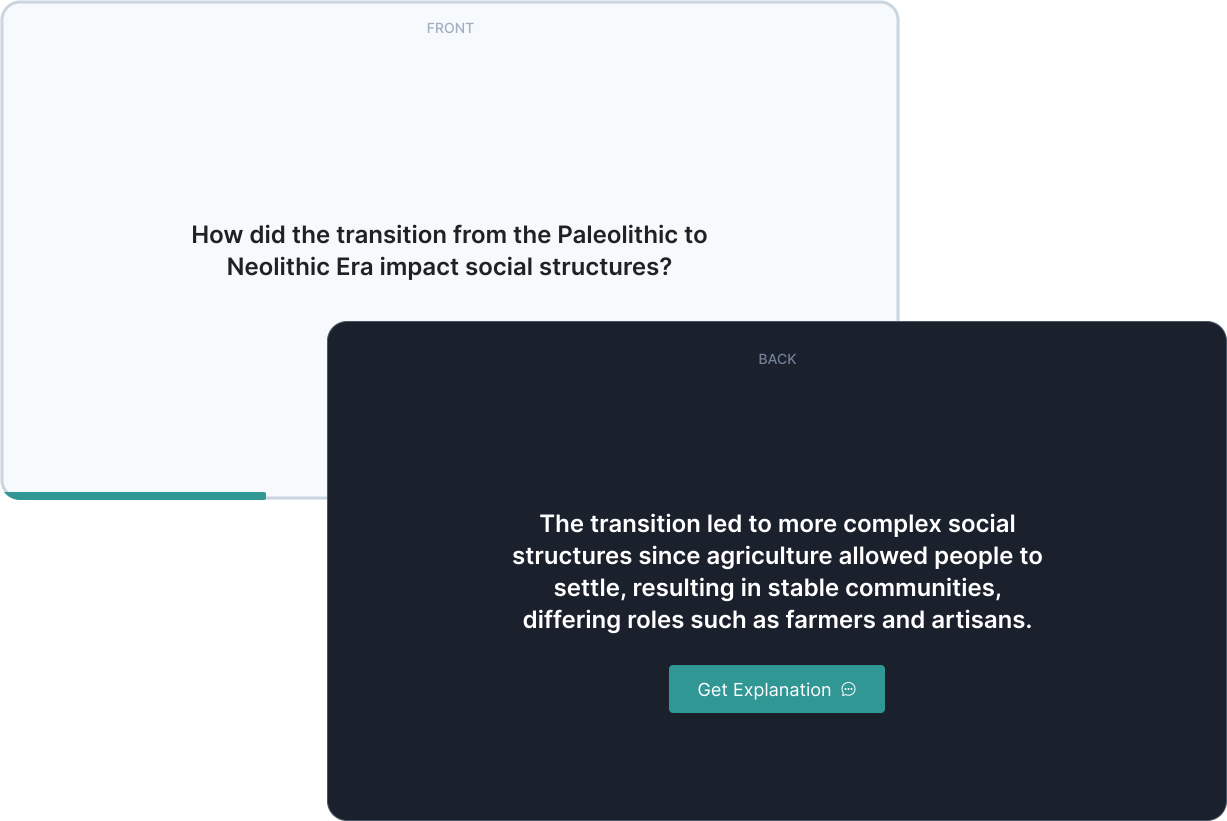
We forget a large portion of what we learn within a month—unless we review it at specific intervals. Traditional studying relies on manual scheduling, which is prone to failure. TurinQ’s AI flashcard maker incorporates a spaced repetition algorithm. It tracks your performance on every card and schedules reviews right at the point of “optimal challenge.” This ensures maximum learning efficiency by spending your time on the material you find most difficult.
Bloom’s Taxonomy and Cognitive Depth
A major critique of early AI tools was that they only handled surface-level facts. TurinQ solves this by integrating Bloom’s Taxonomy. Students can customize their AI Study to generate questions that move from “Remembering” to “Analyzing” and “Creating.” This ensures that you aren’t just memorizing definitions but are developing the critical thinking skills required for high-level university exams.
Reducing the Feedback Gap
In a traditional classroom, you might wait a week for a grade. By then, your brain has often moved on. AI Grading and AI Feedback provide a hyper-loop of correction. When you answer a question on TurinQ, the AI Explanation provides immediate reasoning. This immediate feedback loop is one of the strongest predictors of rapid skill acquisition and improved GPA.
Create Your AI Study for Free
Experience the evidence-based results of AI powered learning yourself. Join thousands of students who have already optimized their study sessions with TurinQ.

Final Thoughts
Do AI study tools really work? The evidence says yes—provided the tools are used to facilitate active recall and spaced repetition rather than just provide answers. TurinQ stands at the forefront of this movement, offering an integrated platform that respects how the human brain actually learns. By using AI to automate the logistics of studying, you free up your mind for deep understanding and long-term mastery.
Frequently Asked Questions
Does using AI make students lazier?
Quite the opposite. By using TurinQ to generate quizzes, students engage in more frequent and difficult self-testing than they would using traditional, passive methods.
Can TurinQ handle complex file types like audio or video?
Yes! TurinQ supports video and audio files. The AI processes the content and generates study guides and questions from the spoken material.
Is the feedback provided by the AI accurate?
TurinQ uses advanced models to provide AI Explanations. While AI content should always be reviewed, our platform is designed for academic accuracy across 90+ languages.
How does the Bloom’s Taxonomy feature work?
When you generate a quiz, you can select the Knowledge Level. Selecting a higher level will prompt the AI to create more complex, scenario-based questions rather than simple definitions.
Table of Content
Recent Posts



Shapes Flashcards

Number Flashcards

Colors Flashcards
