
Shapes Flashcards
Shapes Flashcards: The Best Way to Teach Kids Basic Geometry
Summary
Cognitive Mapping: Flashcards help kids relate abstract symbols (like a triangle) to real-world objects (like a slice of pizza).
Vocabulary Growth: Learning “geometry language”—words like edge, corner, curve, and solid—boosts overall language development.
Interactive Mastery: Using TurinQ allows parents to generate custom decks that match a child’s specific environment or favorite toys.
Beyond 2D: Modern sets now seamlessly integrate 3D shapes (spheres, cubes, cylinders) to build a complete geometric foundation.
Geometry is everywhere—from the round buttons on a shirt to the rectangular doors of a house. For a preschooler, the world is a giant puzzle. Shapes flashcards provide the key to solving that puzzle. In 2026, the best teaching methods combine traditional “hands-on” play with AI-enhanced customization through TurinQ.
The "Identify & Compare" Strategy
The secret to teaching geometry isn’t just naming the shape; it’s understanding its properties.
Start with the Basics: Focus on the “Big Four”—Circle, Square, Triangle, and Rectangle.
Focus on Attributes: Instead of just saying “This is a square,” use the flashcard to count: “Look, it has one, two, three, four straight sides!”
Spot the Difference: Hold up a square and a rectangle. Ask, “How are these the same? How are they different?” This builds critical thinking and observation skills.
Interactive Shape Games for 2026
Flashcards should be the “launchpad” for active movement. Try these high-energy games:
The Shape Hunt: Show a “Circle” card. Give the child 60 seconds to find three circular objects in the room (a clock, a plate, a coin).
Body Geometry: Can you make a triangle with your fingers? Can two people make a square with their arms? Use the flashcard as a reference for these “human shapes.”
The “Feel it” Challenge: Place a shape card and a corresponding 3D object (like a ball for a circle) in a “mystery bag.” Have the child feel the object and guess the shape based on the card.
Leveraging TurinQ for Modern Geometry
In 2026, you don’t have to rely on generic store-bought cards. TurinQ AI Study allows you to create a personalized geometric world:
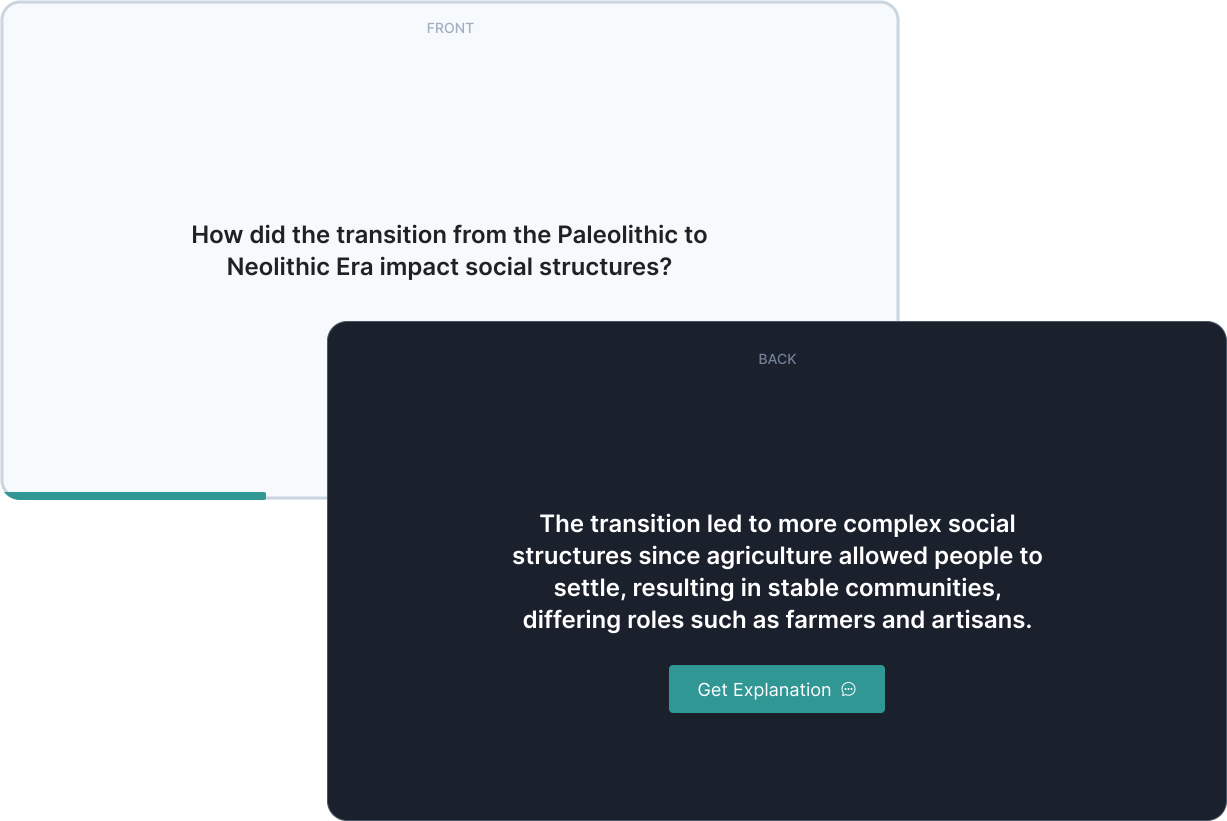
Real-World Photo Decks: Upload photos of your own home—the “Triangle Roof” of the doghouse or the “Rectangle Screen” of the TV—and let the AI turn them into shapes flashcards.
3D Exploration: Ask the AI to “generate a deck comparing 2D shapes to 3D solids” (e.g., Circle vs. Sphere).
Spaced Repetition: Use TurinQ’s Memorize Mode to track which shapes your child struggles with. Does the “Hexagon” keep getting confused with the “Pentagon”? The AI will prioritize those cards until they are mastered.
Building Spatial Language
Geometry is as much about where things are as what they are. Use your flashcards to teach positional words:
“Put the Square card on top of the book.”
“Put the Triangle card under the chair.”
“Put the Circle card next to the toy car.” This integrates geometry with spatial awareness, a key predictor of future success in STEM subjects.
Start with TurinQ for free today!
Don’t let the vocabulary of medicine hold you back from your white coat. Master the terminology with the most advanced student productivity tools available.
Final Thoughts
Shapes flashcards are a child’s first “map” of the universe. By combining the visual clarity of flashcards with the interactive power of TurinQ, you turn a basic math lesson into an exciting adventure. In 2026, the goal isn’t just to recognize a circle—it’s to understand the symmetry, logic, and beauty of the world around us.
Frequently Asked Questions
At what age should I start teaching 3D shapes?
Once a child is confident with 2D shapes (usually age 3 or 4), start introducing solids like the Sphere, Cube, and Cylinder. Use flashcards that show the 3D depth to help them visualize.
Why does my child call every four-sided shape a "Square"?
This is a common stage in development. Use shapes flashcards to point out the specific differences—like how a rectangle has two long sides and two short sides, while a square’s sides are all the same.
Can I print my custom shape cards from TurinQ?
Yes! You can generate a deck with your own images and labels and export it as a printable PDF. Laminating these cards makes them perfect for classroom “Shape Hunts.”
How do flashcards help with "Spatial Reasoning"?
They force the brain to rotate and analyze images. When a child sees a triangle flashcard upside down, their brain learns that the shape is still a triangle regardless of its orientation.
Table of Content
Recent Posts


Shapes Flashcards

Number Flashcards

Colors Flashcards
