
History Memorization Made Easy: Mind Mapping, Storytelling & Visualization Tips
History Memorization Techniques
Mastering history requires more than rote memorization—it demands techniques that connect events, people, and concepts into meaningful narratives. Mind mapping, storytelling, and visualization methods transform isolated historical facts into interconnected knowledge networks, helping students not only retain information but also understand the complex relationships between historical elements.
Memory Palace for Historical Figures
The memory palace technique, also known as the method of loci, is a powerful mnemonic strategy for memorizing historical figures and their achievements. Dating back to ancient Greece and Rome, this method was used by orators like Cicero but has roots in indigenous cultures worldwide that used landscape features to store cultural knowledge. To create a memory palace for historical figures:
Choose a familiar location (your home, school, or a familiar route) and mentally assign specific historical figures to different locations along your journey.
Create vivid, unusual mental images that connect the historical figure to their location—the stranger and more vivid the association, the better it will stick in memory.
For each historical figure, add layers of information by incorporating visual elements that represent their accomplishments, time period, or significance.
Practice mentally walking through your memory palace regularly, retrieving information about each historical figure as you “visit” their assigned location.
Consider expanding your system to include chronological arrangements or thematic groupings that help establish relationships between historical figures.
This technique has proven remarkably effective for memory champions and students alike, with practitioners reporting significant improvements in recall ability for complex historical information. The key to success lies in creating personally meaningful associations and regularly practicing retrieval through your mental journey.
Color-Coding Timeline Techniques
Color-coding transforms historical timelines from monotonous chronologies into visually organized knowledge systems that enhance both comprehension and retention. When implementing color-coding for historical study, establish a consistent and intuitive system—use red for conflicts and revolutions, blue for political developments, green for cultural movements, and purple for technological advancements. This visual categorization helps your brain quickly identify patterns and relationships across historical periods.
For maximum effectiveness, apply your color scheme consistently across all study materials—notes, flashcards, and digital resources. Consider using different color intensities to indicate importance levels (bright colors for pivotal events, lighter shades for supporting details). When reviewing historical material, create a color-coded calendar that prioritizes study topics based on urgency—red for immediate review needs, yellow for concepts requiring reinforcement, and green for well-mastered material. This approach not only organizes information visually but also transforms passive reading into active engagement with historical content, significantly improving recall during exams.
Active Recall Through Debates
Active recall through historical debates transforms passive learning into dynamic knowledge retrieval, significantly enhancing retention of complex historical information. This technique involves challenging yourself to verbally defend historical positions, explain cause-and-effect relationships, or argue from the perspective of historical figures without referencing notes. By forcing your brain to retrieve and articulate historical knowledge under pressure, you strengthen neural pathways associated with that information, making it more accessible during exams.
To implement this method effectively, organize structured debate sessions where you must support historical arguments with specific evidence, create counterpoint flashcards that challenge your understanding of historical events, or use the Feynman Technique to explain historical concepts as if teaching them to someone else. This approach is particularly powerful when combined with other active learning strategies like self-testing and practice questions. The cognitive challenge of defending historical interpretations not only improves factual recall but also develops critical thinking skills essential for higher-level historical analysis.
Spaced Repetition for Dates
Spaced repetition is a powerful learning technique particularly well-suited for mastering historical dates and events. Unlike cramming, which leads to rapid forgetting, spaced repetition strategically schedules reviews at increasing intervals to strengthen long-term memory retention. This method originated with early psychologists in the 19th century, evolved through Sebastian Leitner’s flashcard system in the 1970s, and was revolutionized by Piotr Wozniak’s SuperMemo algorithms in the 1980s.
For history students, implementing spaced repetition is straightforward and effective. Create flashcards with key dates, events, or figures on one side and details on the other. Begin by reviewing new material daily, then gradually increase intervals between reviews as your recall improves—from days to weeks. This approach is especially valuable for history classes where remembering numerous dates and interconnected events is crucial. Consider using digital spaced repetition apps that automatically adjust review schedules based on your performance, or collaborate with classmates to create shared flashcard decks that make the learning process more engaging.
TurinQ: AI-Powered Memory Optimization
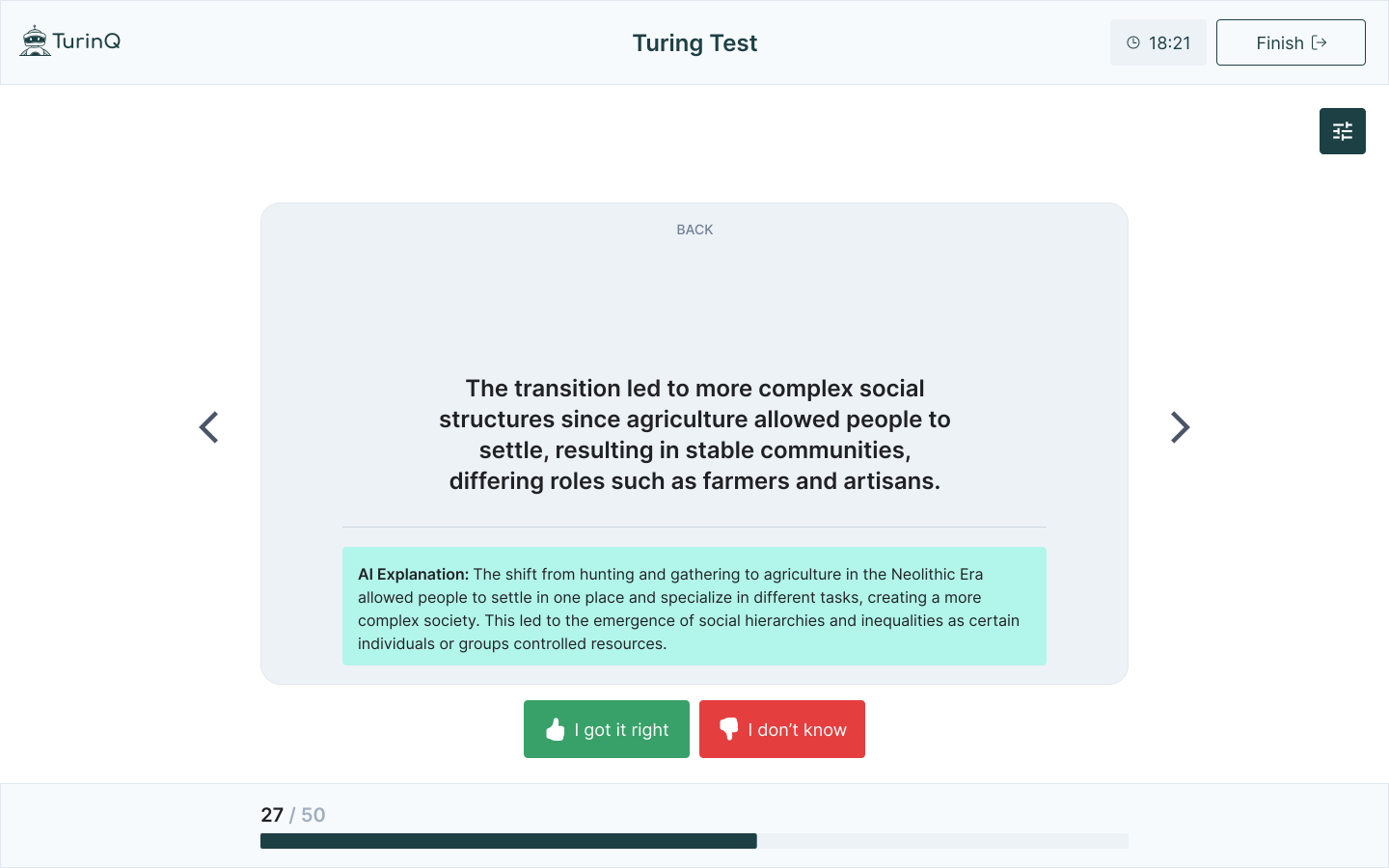
TurinQ’s AI-powered flashcard system revolutionizes the traditional spaced repetition approach with features specifically designed for history students. The platform allows you to create custom flashcards with text, images, and audio for multi-sensory learning of historical content. What sets TurinQ apart is its AI Flashcard Mode: Memorize, which builds on Ebbinghaus’ forgetting curve and Leitner’s system to optimize your study schedule – prioritizing difficult historical concepts while spacing out review of mastered material.
The system offers remarkable flexibility for history students with customizable settings including shuffle options, AI explanations for complex historical concepts, and adjustable card direction. You can easily convert your history notes into flashcards, organize them into thematic decks, and track your progress through performance analytics that identify weak areas requiring additional focus. This approach is particularly valuable for mastering the extensive timelines, figures, and events typical in history courses, as the AI adapts to your performance, ensuring you review critical information just before you’re likely to forget it.
Unique Learning Advantages
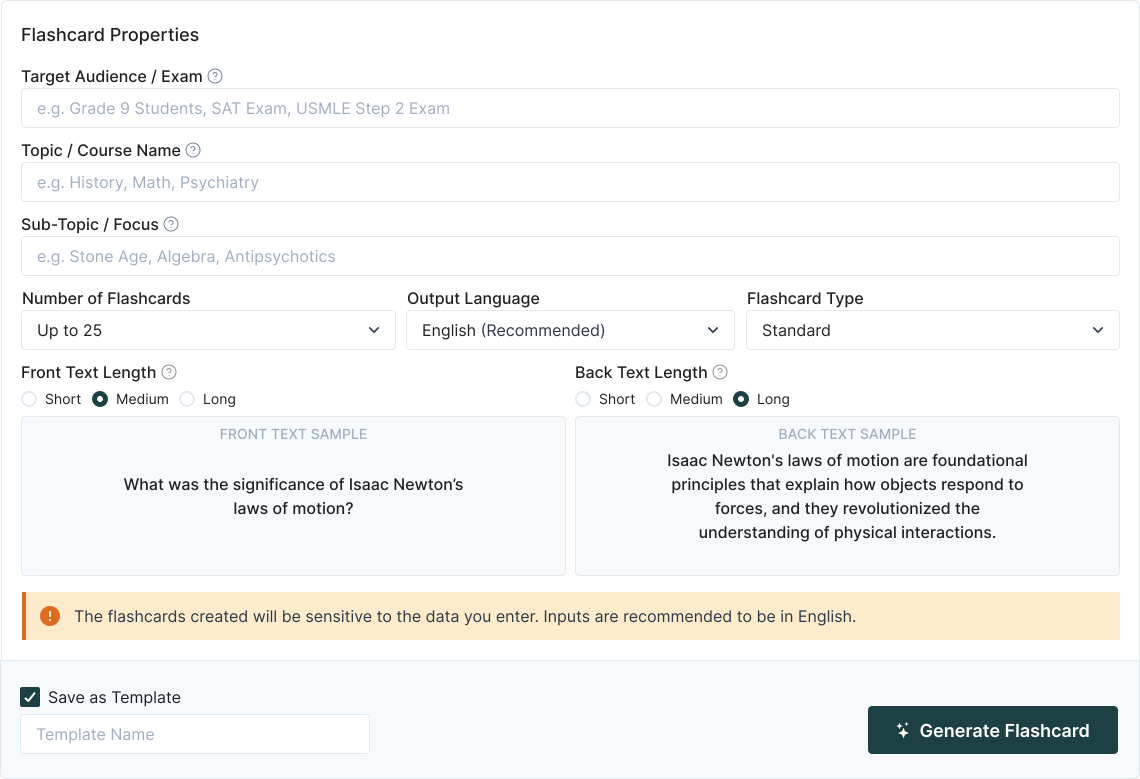
TurinQ stands out from other flashcard platforms through its comprehensive AI-powered learning ecosystem that goes beyond basic memorization. Unlike traditional flashcard apps, TurinQ offers personalized learning experiences with audience-specific customization that adapts content complexity based on your knowledge level—whether you’re a high school student or postgraduate learner. The platform’s versatility is evident in its ability to transform various content formats, including handwritten notes, into interactive study materials.
What truly differentiates TurinQ is its integration of advanced educational features within a cohesive system. The platform combines spaced repetition technology with interactive learning approaches that make studying more dynamic and engaging. Users can generate flashcards directly from their content or use the Smart Generated feature to automatically create cards based on target audience, topic, and subtopic. Additionally, TurinQ offers flexible study modes with personalized dashboards for progress tracking and instant feedback, transforming passive content consumption into an active learning experience that enhances long-term retention and deeper understanding of complex subjects.
Final Memory Mastery
Effective history memorization combines strategic approaches with consistent practice. The most successful students don’t just memorize isolated facts but create meaningful connections between events, figures, and concepts. Focus on understanding the broader historical narrative rather than fixating on every date and name—prioritize key themes your instructor emphasizes. When studying, engage actively through techniques like self-quizzing, explaining concepts aloud, and working through practice questions rather than passively rereading notes.
Remember that visual tools significantly enhance retention—create flowcharts for sequencing events, use color-coding for categorization, and develop timelines to visualize historical progression. Incorporate mnemonic devices for key dates and implement spaced repetition to review material at increasing intervals rather than cramming. Most importantly, find personal connections to historical content by approaching it as “ancient gossip”—the human stories of who did what, why it mattered, and how it shaped subsequent events. This combination of structured techniques and meaningful engagement transforms history from a memorization challenge into an engaging exploration of our shared past.
Frequently Asked Questions
What are AI Flashcards?
AI Flashcards are automatically generated flashcards based on the content you upload, such as lecture notes, textbooks, or documents. The AI analyzes the material and creates questions and answers that are relevant to the subject, helping you study more effectively.
How do I create my own flashcards?
You can upload your content (e.g., text, PDFs, videos, audio, or URLs) or use smart generated into the platform. The AI then generates flashcards by summarizing key concepts and converting them into question-and-answer format.
What is Spaced Repetition in AI Flashcards?
Spaced Repetition is a learning technique that schedules flashcard reviews at increasing intervals, based on your performance. The AI prioritizes cards you struggle with and gradually spaces out the review of cards you’ve mastered, helping you retain information for the long term.
What's the most effective technique for memorizing historical dates?
Active recall is consistently ranked as the most effective technique for memorizing historical dates and events. Instead of passively rereading notes, test yourself by creating flashcards with dates on one side and events on the other, then quiz yourself regularly. Mnemonics like “In 1492, Columbus sailed the ocean blue” also create memorable associations that stick in your memory. For complex chronologies, creating a visual timeline with color-coding helps establish relationships between events and their sequence.
How can I remember complex historical processes?
Break down complex historical processes using visual diagrams and flowcharts. Mind maps are excellent for connecting related concepts, while cause-and-effect diagrams help visualize how events influenced each other. The Memory Palace technique is particularly powerful for remembering intricate historical narratives—place vivid images representing historical events at specific locations in a familiar setting (like your home) and mentally “walk through” to recall the information. Combining these visualization methods with active learning techniques like teaching concepts to others significantly enhances retention of complex historical processes.
References
Memory Palace Technique
National Geographic. (n.d.). Memory palace technique. https://www.nationalgeographic.com/health/article/memory-palace-technique
McGill University. (n.d.). Ancient memory technique still puzzles scientists. https://www.mcgill.ca/oss/article/critical-thinking-history/ancient-memory-technique-still-puzzles-scientists
Wikipedia. (n.d.). Method of loci. https://en.wikipedia.org/wiki/Method_of_loci
Magnetic Memory Method. (n.d.). How to memorize the presidents. https://www.magneticmemorymethod.com/how-to-memorize-the-presidents/
Aeon. (n.d.). This ancient mnemonic technique builds a palace of memory. https://aeon.co/ideas/this-ancient-mnemonic-technique-builds-a-palace-of-memory
Magnetic Memory Method. (n.d.). Memory palace ideas. https://www.magneticmemorymethod.com/memory-palace-ideas
Color-Coding in History Study
eLearning Industry. (n.d.). Guide to color coding in eLearning. https://elearningindustry.com/guide-color-coding-elearning
Central Washington University. (n.d.). Color coding textbook reading. https://www.cwu.edu/academics/academic-resources/learning-commons/_documents/cwu-color-coding-textbook-reading-lc.pdf
Noji.io. (n.d.). How to use color coding for studying. https://noji.io/de/blog/how-to-use-color-coding-for-studying/?from=ankipro
YouTube. (n.d.). How to color-code your notes. https://www.youtube.com/watch?v=RLLZgCvTk2k
Straw Blondie Studies. (n.d.). Effective colour coding. https://www.strawblondiestudies.co.uk/post/effective-colour-coding
Reddit. (n.d.). Color coding techniques for notes. https://www.reddit.com/r/GradSchool/comments/108zwtp/colorcoding_techniques_for_notes/
Active Recall Through Debates
Oxford Summer Courses. (n.d.). How to improve active recall. https://oxfordsummercourses.com/articles/how-to-improve-active-recall
Birmingham City University. (n.d.). Best ways to revise – Active recall. https://www.bcu.ac.uk/exams-and-revision/best-ways-to-revise/active-recall
Vaia. (n.d.). Active recall in psychology. https://www.vaia.com/en-us/explanations/psychology/memory-studies-in-psychology/active-recall/
Reddit. (n.d.). How to use active recall. https://www.reddit.com/r/study/comments/lfw40h/how_to_use_active_recall_the_best_study_strategy/
Imperial Valley College. (n.d.). Active recall study method. https://former-students.imperial.edu/004-book/article?dataid=wnG16-1541&title=active-recall-study-method.pdf
FourWeekMBA. (n.d.). Active recall. https://fourweekmba.com/active-recall/
Spaced Repetition for History
Noji.io. (n.d.). Spaced repetition method. https://noji.io/blog/spaced-repetition/
Pinterest. (n.d.). Important dates in world history flashcards. https://www.pinterest.com/pin/20-most-important-dates-in-world-history-flashcards–578853358379847207/
Brainscape. (n.d.). History dates pack. https://www.brainscape.com/packs/history-dates-11576260
Wikipedia. (n.d.). Spaced repetition. https://en.wikipedia.org/wiki/Spaced_repetition
YouTube. (n.d.). How to use spaced repetition. https://www.youtube.com/watch?v=AuP38JzR5bw
31 Memorize. (n.d.). Using spaced repetition for history facts. https://www.31memorize.com/post/how-to-use-spaced-repetition-for-history-facts
Reddit. (n.d.). How to learn dates and facts. https://www.reddit.com/r/GCSE/comments/12hqkil/other_than_flashcards_how_do_you_learn_dates_and/
Traverse. (n.d.). The spaced repetition method. https://traverse.link/spaced-repetition/the-spaced-repetition-method
TurinQ’s AI-Powered Flashcard System
TurinQ. (n.d.). 5 steps to master memory retention with TurinQ Flashcard. https://turinq.com/5-steps-to-master-memory-retention-with-turinq-flashcard/
TurinQ. (n.d.). AI flashcard maker. https://turinq.com/ai-flashcard-maker/
AI Tools Inc. (n.d.). TurinQ review. https://aitools.inc/tools/turinq
Notion. (n.d.). Spaced repetition flashcards template. https://www.notion.com/templates/spaced-repetition-flashcards-3
Memrizz. (n.d.). Turn notes into flashcards instantly. https://www.memrizz.com/blogs/turn-notes-into-flashcards-instantly-the-ai-hack-students-swear-by
Voovo Study. (n.d.). Spaced repetition study tips. https://www.voovostudy.com/study-blog/spaced-repetition-unlocking-its-power
Reddit. (n.d.). Flashcard app discussion. https://www.reddit.com/r/quizlet/comments/1fdiodb/how_do_i_turn_on_spaced_repetition_on_my/
Notion. (n.d.). Spaced repetition flashcard system. https://www.notion.com/templates/spaced-repitition-flashcard-system
Noji.io. (n.d.). Spaced repetition blog. https://noji.io/blog/spaced-repetition/
RemNote. (n.d.). RemNote spaced repetition. https://www.remnote.com
TurinQ vs Others – Platform Comparison
TurinQ. (n.d.). 10 best AI flashcard generators in 2025. https://turinq.com/10-best-ai-flashcard-generators-in-2025/
TurinQ. (n.d.). Knowt vs TurinQ – Best alternative. https://turinq.com/knowt-vs-turinq-the-best-knowt-alternative/
TurinQ. (n.d.). TurboLearn AI vs TurinQ. https://turinq.com/turbolearn-ai-vs-turinq-com-my-hands-on-comparison/
TurinQ. (n.d.). Mindgrasp AI vs TurinQ. https://turinq.com/mindgrasp-ai-vs-turinq-com-which-ai-study/
YouTube. (n.d.). TurinQ platform walkthrough. https://www.youtube.com/watch?v=OOsWeMR_I-c
Reddit. (n.d.). Best flashcard app opinions. https://www.reddit.com/r/languagelearning/comments/1i0c0yc/what_is_the_best_flashcard_app_in_your_opinion/
AlgoEducation. (n.d.). Best flashcard apps. https://www.algoreducation.com/en/blog/best-flashcard-app
TurinQ. (n.d.). Sporcle vs TurinQ comparison. https://turinq.com/sporcle-vs-turinq-comparison/
College Info Geek. (n.d.). Top flashcard apps. https://collegeinfogeek.com/flashcard-apps/
Lexplorers. (n.d.). Flashcard app showdown. https://lexplorers.com/flashcard-app-showdown-quizlet-vs-anki-vs-memrise/
General History Memorization Strategies
Beyond Tutors. (n.d.). Best memorization techniques for history or science. https://www.beyond-tutors.com/resources/insights/what-are-the-best-memorization-techniques-for-subjects-like-history-or-science/
LearningBox. (n.d.). Memory methods for learners. https://learningbox.online/en/column/blog-15-memory-method/
Structural Learning. (n.d.). Effective memorization techniques. https://www.structural-learning.com/post/8-effective-memorization-techniques
Reddit. (n.d.). How to learn history efficiently. https://www.reddit.com/r/history/comments/lxk4fw/how_to_learn_history_efficiently_as_a_student/
SigmaOS. (n.d.). Memory improvement methods for history students. https://sigmaos.com/tips/students/best-memory-improvement-methods-for-history-students
MindGrasp. (n.d.). How to cram for a history exam. https://www.mindgrasp.ai/blog/how-to-cram-for-a-history-exam
The Tech Edvocate. (n.d.). 5 ways to memorize history lessons. https://www.thetechedvocate.org/5-ways-to-memorize-history-lessons/
YouTube. (n.d.). History exam memory tips. https://www.youtube.com/watch?v=bNu26dHGDtY
Book Units Teacher. (n.d.). Memorization resources. https://bookunitsteacher.com/wp/?p=7301
Careers360. (n.d.). 9 tricks to memorize history. https://www.careers360.com/webstories/9-exciting-tricks-to-memorise-history/
Table of Content
Recent Posts



Shapes Flashcards

Number Flashcards

Colors Flashcards
