
Medical Terminology Flashcards
How Medical Terminology Flashcards Improve Recall and Exam Performance
Summary
Breaking Down Complexity: Using AI powered learning to deconstruct Greek and Latin roots instantly.
Securing Long-Term Memory: Utilizing spaced repetition to ensure vital terms aren’t forgotten after the midterm.
Simulating High-Stakes Exams: Transforming textbooks and lecture recordings into interactive practice sets.
Personalized Feedback: Using an AI Tutor to explain the “why” behind anatomical and clinical terms.
In the rigorous world of healthcare education, mastering the language of medicine is the foundation of clinical success. However, the sheer volume of prefixes, suffixes, and anatomical terms can overwhelm even the most dedicated students. In 2026, the secret to surviving med school is no longer just brute-force memorization—it’s using medical terminology flashcards powered by TurinQ.
The Science of Active Recall in Medicine
Passive studying is a risk in medical education. Reading about a “myocardial infarction” is not the same as being able to define it under pressure. Medical terminology flashcards force active recall, which strengthens the neural connections required for clinical reasoning. By using TurinQ to generate questions from content, you turn static lecture slides into a dynamic challenge that prepares your brain for the high-stakes environment of board exams.

Mastering Latin and Greek Roots with AI
Most medical terms are built from a limited set of roots. Instead of wasting hours manually writing cards for “hepat-“, “nephr-“, or “-itis”, students are using the TurinQ AI flashcard maker.
Instant Automation: Upload a PDF of your anatomy textbook or a link to a surgical video.
Multi-Format Extraction: The AI identifies the core terminology and builds a deck of medical terminology flashcards in seconds. This allows you to focus on the relationships between terms rather than the tedious process of card creation.
Beating the Forgetting Curve with Spaced Repetition
Medical knowledge is cumulative. What you learn in Semester 1 is vital for Semester 4. The TurinQ platform integrates spaced repetition into its medical terminology flashcards. The algorithm tracks your performance; it knows if you are struggling with cardiovascular terms but have mastered neurology. By showing you the difficult cards at the optimal moment, it ensures you learn faster with AI and maintain a high level of retention throughout your entire degree.
Clinical Context via AI Explanations
A flashcard that only gives a one-word definition is insufficient for a future clinician. When you use the TurinQ medical terminology flashcards, every card is supported by an AI explanation. If you miss a term, the AI Tutor provides the clinical context, usage in a patient scenario, and related anatomical structures. This transforms simple memorization into deep understanding, which is the key to superior exam performance.
Scaling with Bloom’s Taxonomy for Boards
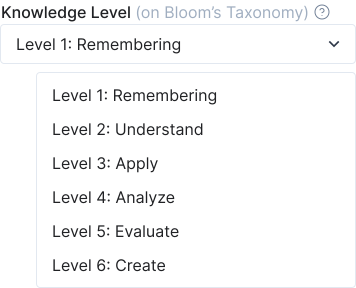
Board exams like the USMLE don’t just ask for definitions; they ask for application. TurinQ allows you to set the “Knowledge Level” for your medical terminology flashcards based on Bloom’s Taxonomy.
Level 1 (Recall): “Define tachycardia.”
Level 3 (Application): “Identify the Greek root in this clinical presentation of a heart rate over 100 bpm.” This prepares you for the critical thinking required in modern healthcare assessments.
Start with TurinQ for free today!
Don’t let the vocabulary of medicine hold you back from your white coat. Master the terminology with the most advanced student productivity tools available.

Final Thoughts
Medical terminology flashcards are the most effective way to manage the massive cognitive load of a healthcare education. By combining the psychological benefits of active recall and spaced repetition with the automation of TurinQ, you can significantly improve your exam performance and clinical confidence. In 2026, the best clinicians aren’t just the ones who work the hardest—they are the ones who study the smartest
Frequently Asked Questions
Can I use TurinQ to create flashcards from my recorded clinical lectures?
Yes! You can upload .mp3, .wav, or .mp4 files. The AI will analyze the audio and generate medical terminology flashcards based on the specific terms mentioned by your professor.
Does TurinQ support images for anatomy flashcards?
Absolutely. You can use anatomical diagrams as source material to generate “Identify the structure” style flashcards, which is essential for anatomy exam preparation.
How do I handle very long medical textbooks?
You can upload specific page ranges or chapters to TurinQ. The AI will then focus its vocabulary quiz generator on the most important terms within that specific section.
Can I share my medical flashcard decks with my study group?
Yes. You can export your decks as PDFs or JSON files, making it easy to collaborate with other students and ensure your entire cohort is ready for the final.
Table of Content
Recent Posts



Shapes Flashcards

Number Flashcards

Colors Flashcards
