
Active Recall (2025 Guide): Study Smarter – And Why TurinQ Beats Mindgrasp for Real Mastery
Active Recall (2025 Guide): Study Smarter
Summary
- Active recall is the most proven way to boost long-term retention—when you generate answers from memory, not just reread notes.
- Mindgrasp centers on fast summaries and “key takeaways,” which is convenient but mainly supports passive review. TurinQ is built for active practice, higher-order thinking, and measurable progress.
- With TurinQ you can turn PDFs, slides, YouTube videos, audio lectures, and even handwritten notes into quizzes, open-ended prompts, and spaced-repetition decks—then get AI grading and targeted insights to close your gaps.
What is Active Recall— and why should students care?
Active recall means retrieving information from memory (by answering questions, teaching, or solving problems) instead of simply rereading or highlighting. It reliably outperforms passive review for long-term retention and exam performance.
The punchline: if your study routine is mostly summaries, you’ll feel productive but memorize less. The fix is systematic self-testing.
The common traps (and how to avoid them)
- Trap 1: Endless summaries. Summaries compress content—but they don’t force recall. Mindgrasp’s feature set and blog focus heavily on speed-reading aids like short summaries and key takeaways, which encourage skimming rather than retrieval.
- Trap 2: One-level questions. Memorizing definitions won’t carry you through application-heavy courses. TurinQ aligns practice to Bloom’s Taxonomy so you can progress from “remember” to “analyze” and “evaluate.”
- Trap 3: No feedback loop. If you never see what you consistently miss, you can’t prioritize. TurinQ’s AI Insights surfaces your weak cognitive levels/topics so your next session targets exactly what matters.
Step-by-step: Active recall the TurinQ way
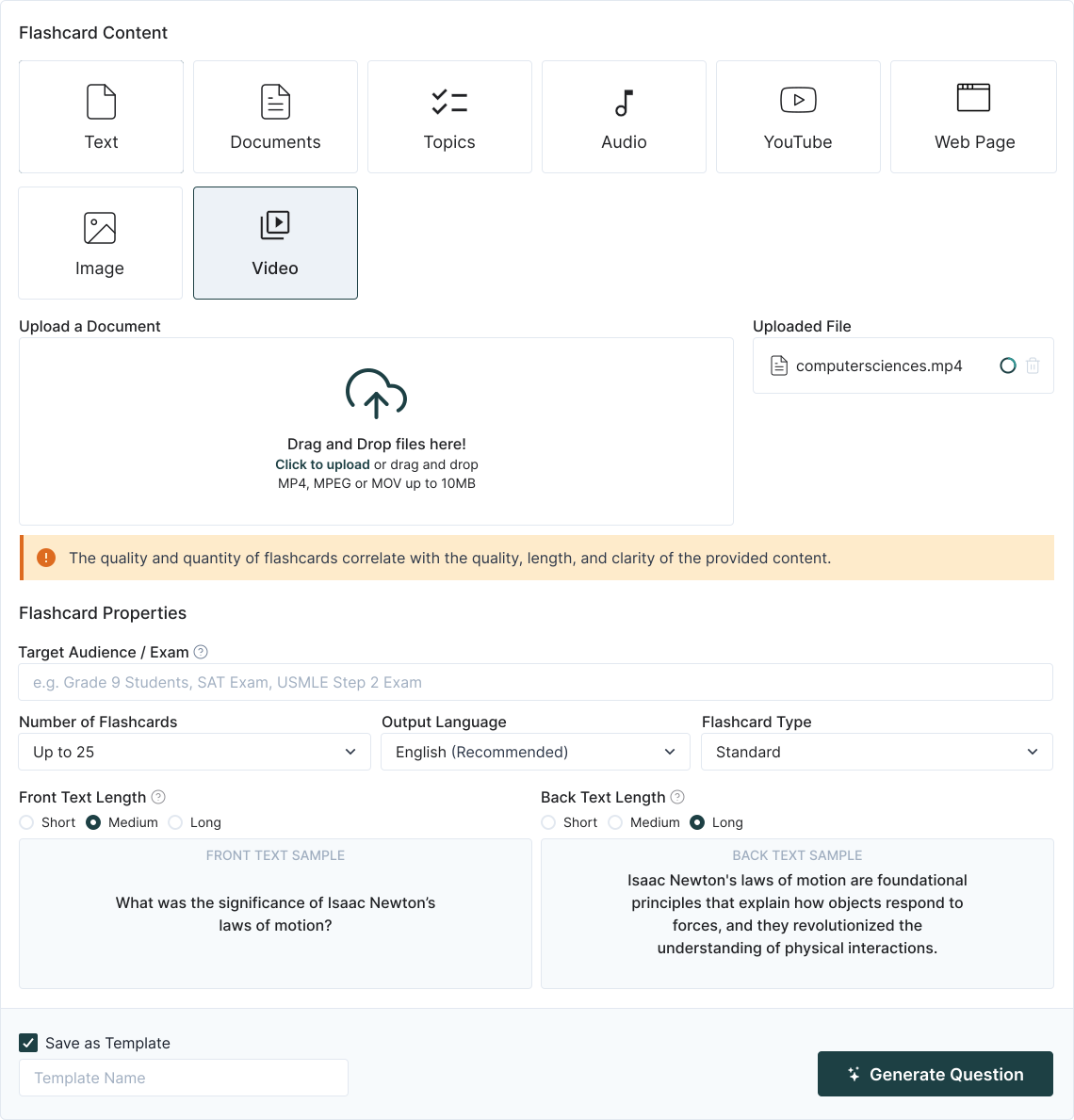
- Import your materials (all of them).
Upload PDFs, lecture slides, and course notes to auto-build a rich question bank.
Paste a YouTube link to turn lectures into practice questions and study notes.
Drop podcast/audio files for transcripts, key concepts, and quizzes.
Snap a photo of handwritten notebook pages; convert to text and quizzes. - Generate multi-level questions (not just flashcards).
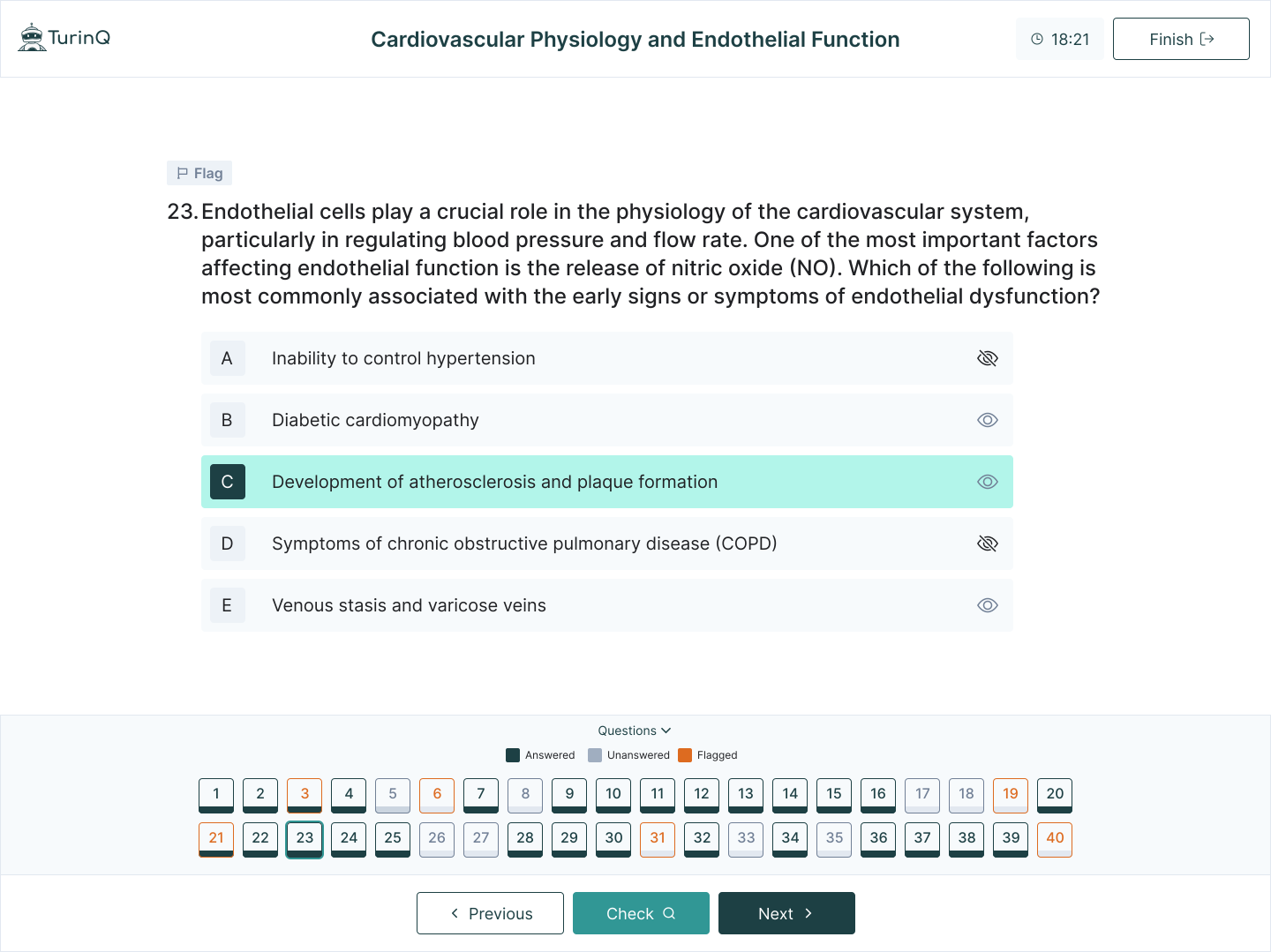
Create MCQs, T/F, short-answer, and scenario prompts mapped to Bloom’s levels—so you practice understanding, application, analysis, and evaluation, not only recall. - Practice, get graded, iterate.
TurinQ auto-grades objective items and uses AI for open-ended scoring with semantic feedback—ideal for essays, problem explanations, and case analyses. - Zero in on gaps with AI Insights.
See which topics or cognitive levels you miss most, then auto-generate targeted drills. - Lock it in with spaced repetition.
Automatically spin up decks for terms and formulas; schedule reviews to retain over weeks. (TurinQ’s workflows explicitly pair quizzes with spaced-repetition style card sets.)
Mindgrasp vs. TurinQ for active recall
Study need | Mindgrasp approach | TurinQ approach |
Get the gist fast | Also supports summaries—but as a starting point for practice | |
Turn any source into practice | Focus on summaries/notes | PDFs/slides → question bank; YouTube → interactive practice; audio → transcript & quizzes; handwriting → digitized prompts |
Higher-order thinking | Primarily passive review | Bloom-aligned prompts across levels, including open-ended cases |
Feedback & analytics | Limited recall diagnostics | AI grading + AI Insights to expose weaknesses and guide sessions |
From study to exam-ready | Reading efficiency | Assessment-first design; can export question banks to your LMS when needed |
Mindgrasp’s content engine is optimized for top-of-funnel study queries (pulling traffic with broad academic topics), which suits quick answers but not necessarily deep learning. TurinQ positions itself on pedagogical depth and measurable progress.
A 30-minute active-recall blueprint (today)
- Minute 0–5: Load sources. Upload this week’s slides and the assigned article; paste the lecture link.
Minute 5–15: Warm-up retrieval. Run 10 MCQs at Remember/Understand.
- Minute 15–25: Higher-order push. 3 short-answer prompts at Analyze/Apply on scenarios from your readings.
- Minute 25–30: Review & schedule. Read AI feedback, generate a micro-deck for tough terms, and set spaced reviews.
Repeat this blueprint thrice a week; your retention curve flattens and exam stress drops.
Ready to replace passive review with real learning?
Start with TurinQ for free today!
Ready to move from reading to mastery? Try TurinQ and feel the difference in one session.
Frequently Asked Questions
Isn’t summarization enough if I’m short on time?
Summaries are fine for orientation, but they don’t prove you can recall or apply knowledge. TurinQ shifts you from reading to doing in minutes, which is what boosts scores.
Can I use TurinQ for essay-heavy classes?
Yes—generate prompt banks and get AI scoring on open-ended answers with semantic feedback, then iterate where you’re weak.
What if my materials are scattered across formats?
That’s exactly the point: PDFs/slides, YouTube lectures, audio recordings, even notebook photos all become practice.
Table of Content
Recent Posts



Shapes Flashcards

Number Flashcards

Colors Flashcards
